
When it comes to SEO, forecasting can be a tricky concept.
Key Takeaways
- SEO forecasting still matters, but the inputs and outputs have changed.
- AI Overviews and zero-click behavior are absorbing demand that used to produce clicks. Forecasts built on pre-AI assumptions will now overstate expected traffic.
- The modern forecasting model is probabilistic and scenario-based, not linear. Express outputs as ranges across conservative, expected, and aggressive cases.
- Influence metrics are the bridge that translate SEO visibility into business value. Examples of influence metrics include branded search demand growth, CTR behavior and conversion rates.
- A 90-180 day SEO forecast is only as accurate as its inputs. AI citations, branded search growth, and share of voice are the inputs that matter most.
When it comes to SEO, forecasting can be a tricky concept.
You’re trying to predict the future of your website’s traffic and it can be difficult to know which metrics to focus on. It can also be difficult to know if the metrics you selected are giving you and your team a clear picture.
That picture has gotten harder to read. AI Overviews, zero-click behavior, and LLM-referred traffic have changed what SEO forecasts need to measure and how the results need to be presented.
This is why many SEO forecasts are starting to break down. Rankings may improve while clicks flatten. Traffic may increase without revenue following. And visibility may influence demand long before a user ever lands on your site. Modern SEO forecasting needs to explain that disconnect, not hide it.
In this article, we’ll discuss what SEO forecasting is, and where it is and isn’t effective. We’ll also look at the different types of forecasting you can use, as well as the pros and cons of each method. Finally, we’ll cover some of the overall limitations of SEO forecasting as a concept, and what you may want to consider instead.
Let’s start by discussing the potential value of SEO forecasting in the first place.
What Is SEO Forecasting and Why Does It Matter?
SEO forecasting is the practice of predicting and estimating changes in your website’s search engine visibility. This includes factors such as organic traffic, keyword rankings, and more. By trying to predict the future, you can plan ahead and make educated decisions about how to best optimize your website for search engine results pages (SERPs).
For example, let’s say you noticed that your website is losing traffic due to changes in the SERPs. In this case, you may try to use SEO forecasting to help you identify potential issues and strategize how to improve your website’s visibility.
Knowing where your website stands in terms of SEO today is important, but understanding where it’s going in the future is even more critical. With SEO forecasting, in theory, you can identify potential problems and take action to address them before they become a reality. This could include creating content around specific topics or introducing new strategies like link building.
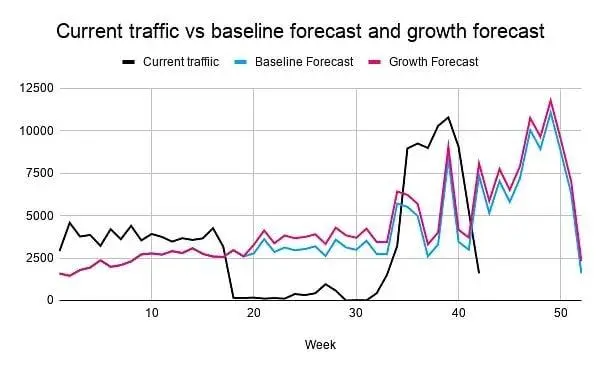
Source: Simplilearn
When used in the right context, SEO forecasting can help give you an idea of performance over time, so you can track progress and adjust as needed. It may also help you stay ahead of the competition and ensure your website is always optimized for success.
With that said, whenever someone asks my NP Digital team about forecasting, we always try to provide a clear picture of what forecasting can and can’t do.
An SEO forecast isn’t going to magically predict the entire future landscape for you. There are too many factors to consider, from seasonality to greater economic trends, that can affect your organic growth and won’t get tracked in any forecast.
So when we talk about SEO forecasting and its benefits, they are best served to help you make decisions, not be your sole source of truth. In addition, if you decide to use them, that needs to be done alongside general best practices like experience, expertise, authoritativeness, and trustworthiness (E-E-A-T), as well as your previous successes or struggles.
Remember, you can’t truly pinpoint search performance until after the fact, which applies to just about any marketing context, really.
The search landscape has also changed materially since most forecasting frameworks were built. AI Overviews, zero-click behavior, and LLM-referred traffic all affect how rankings translate to traffic and how traffic translates to revenue. A forecast that doesn’t account for these shifts will consistently overstate expected results.
Why Most SEO Forecasts Are Breaking Down Now
Most SEO forecasting models were built on assumptions that are no longer relevant. Sessions are often treated as equivalent to conversions. In practice, traffic and conversions have decoupled. AI Overviews are answering queries without producing clicks, which means impression counts can rise while visit counts fall. A model that treats session volume as a reliable conversion proxy will overstate business outcomes.
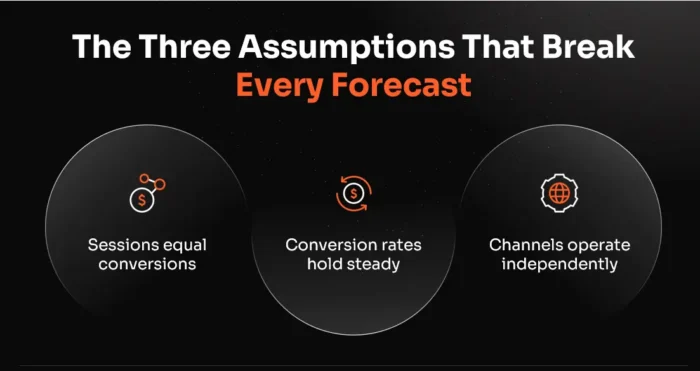
Conversion rates are often held constant, yet they shift with buyer intent, market conditions, and the competitive landscape. A model that holds conversion rate constant across changing conditions will produce projections that drift from reality the longer the forecast runs.
A growing share of searches now end without a click to any website, especially informational and navigational queries where AI-generated answers absorb demand before users reach organic listings. Lumping all query types together in a forecast produces misleading averages, because transactional and commercial queries retain click volume at higher rates.
The fix is not to abandon forecasting. It is to replace linear, single-number projections with probabilistic, scenario-based models that account for these variables from the start.
Types of SEO Forecasting
Modern SEO forecasting is not a single method applied uniformly. It runs across four distinct types, each answering a different business question. Used together, they give you a complete picture of what your SEO program is likely to produce and where the risk sits.
Visibility Forecasting
Visibility forecasting predicts whether your brand will be seen. The key metrics here are impressions, share of voice, and AI visibility across traditional search and AI-generated results.
The business question this type answers is: what will people see?
Visibility is the foundation on which all downstream demand and revenue forecasts are built. Without an accurate picture of how visible your brand will be, every estimate below it is working from an unreliable base. This has become more consequential as AI search and zero-click behavior change how often visibility actually converts into traffic. A brand can gain impressions and lose clicks simultaneously, and a forecast that only tracks one will misread the program’s performance.
Demand Forecasting
Demand forecasting predicts how users will respond after they see your brand. Key metrics include CTR behavior by query type, branded search demand, conversion rates by intent stage, and pipeline creation or online orders.
The business question this type answers is: what will people do?
Demand forecasting converts visibility into measurable business interest. It is where the forecast starts connecting to revenue, and where CTR assumptions by query type matter most. Informational queries produce fewer clicks per impression than transactional ones, particularly in categories where AI Overviews are active. A demand forecast that applies a single blended CTR across all query types will overstate expected traffic. Demand metrics also tend to surface earlier indicators than revenue results, which makes them useful for catching forecast drift before it compounds.
Revenue Forecasting
Revenue forecasting predicts business outcomes. Key metrics include Customer Acquisition Cost (CAC), pipeline velocity, revenue efficiency, and margin contribution.
The business question this type answers is: what will the business get?
Revenue forecasting connects marketing performance to financial outcomes. It is the type most SEO programs skip, and the one leadership cares about most. A program that can forecast CAC and pipeline contribution gives executives the metrics they actually use to evaluate channel investment. It also shifts the conversation from channel activity reporting to business impact, which is where SEO programs earn and maintain budget.
Scenario-Based Forecasting
Scenario-based forecasting predicts a range of outcomes rather than a single number. The standard framework covers a conservative case, an expected case, and an aggressive case.
This type does not replace the other three. It is the structure through which the other three are expressed. Every visibility, demand, and revenue forecast should be run across all scenarios rather than collapsed into a single projection.
Scenario-based forecasting enables risk management, creates more realistic performance expectations, and improves executive alignment. When assumptions shift mid-flight, whether from AI Overview expansion, a budget change, or competitive pressure on core keywords, a single-number forecast breaks. A scenario-based forecast gives leadership a plan for each outcome and a framework for understanding which assumption caused the deviation. It accounts for uncertainty rather than hiding it, which is what makes a forecast useful as a decision tool rather than just a prediction.